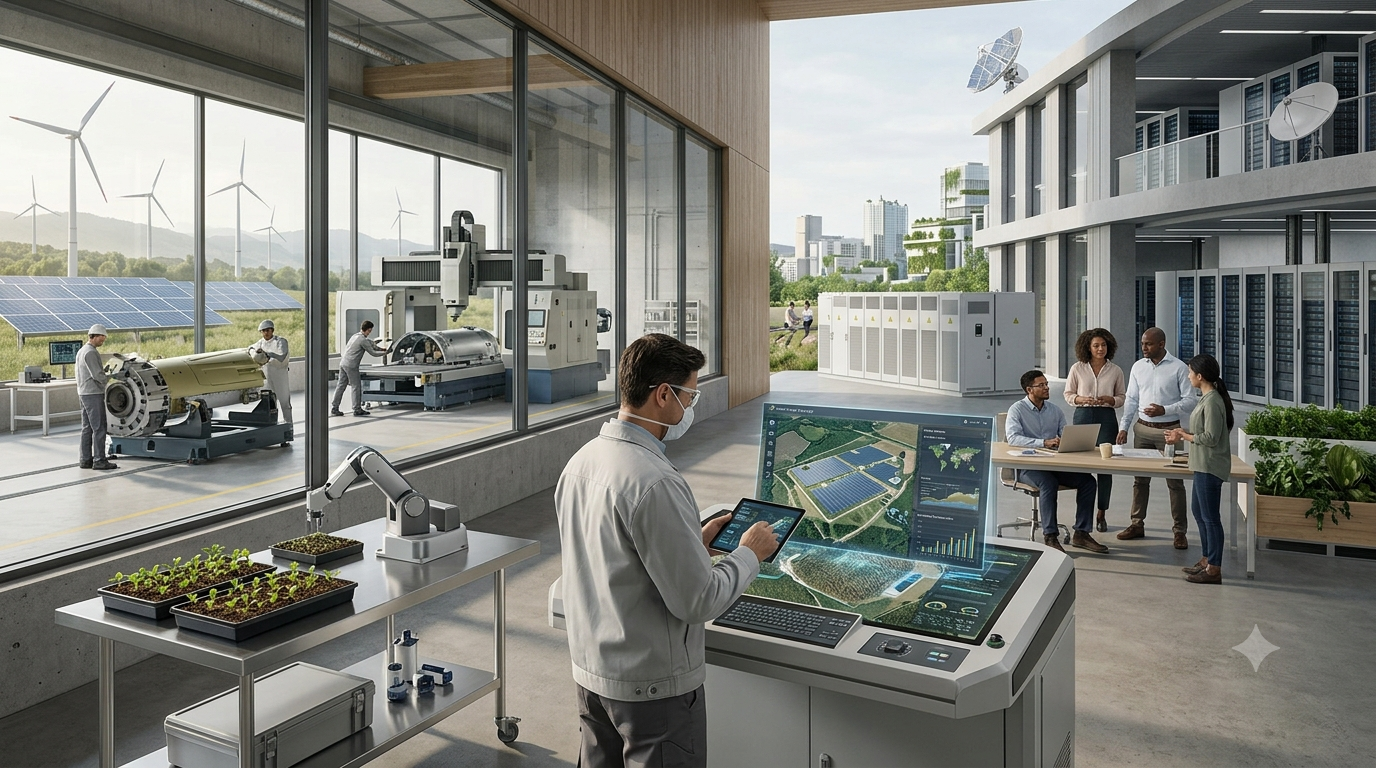
The post-pandemic macroeconomic landscape has entered a decisive period of structural reallocation. The drivers that defined global expansion over the last two decades—cheap capital, frictionless trade, and legacy manufacturing frameworks—are yielding to a complex paradigm powered by technological acceleration, energy transition imperatives, demographic shocks, and supply-chain recalibration.
According to analysis from the International Monetary Fund (IMF), long-term productivity will depend increasingly on capital deployment into tech-enabled and energy-resilient sectors rather than debt-fueled consumption.
As policymakers and global investors navigate this shifting landscape, ten core sectors are emerging as the engines likely to propel the next phase of global economic expansion.
1. Artificial Intelligence and Advanced Computing
Artificial intelligence (AI) and enterprise automation are evolving from speculative tech concepts into core industrial infrastructure. Generative platforms, agentic AI systems, and machine learning models are streamlining workflows, raising output across white-collar sectors, and modernizing physical processes.
-
Enterprise Adoption & Infrastructure: Corporate capital expenditure is shifting heavily toward cloud infrastructure, high-density data centers, and AI model deployment. International Data Corporation (IDC) projects global semiconductor spending driven by AI hardware will push the total semiconductor market past $1 trillion.
-
Automation and Robotics: Beyond code and text, AI integration into manufacturing robotics is lifting industrial efficiency and precision.
-
Economic Bottlenecks: Growth in this sector is not without headwinds. Hyper-scale data centers demand unprecedented amounts of electrical power, creating severe energy grid friction. Furthermore, acute shortages of specialized silicon, high-bandwidth memory (HBM), and specialized talent present immediate scaling hurdles.
┌────────────────────────────────────────────────────────────────────────┐
│                        AI INDUSTRIAL FLYWHEEL                          │
│                                                                        │
│   ┌────────────────────┐            ┌──────────────────────────────┐   │
│   │ Semiconductor &    │───────────>│ Compute Infrastructure &     │   │
│   │ Memory Supply      │            │ High-Density Data Centers    │   │
│   └────────────────────┘            └──────────────────────────────┘   │
│             ▲                                      │                   │
│             │                                      ▼                   │
│   ┌────────────────────┐            ┌──────────────────────────────┐   │
│   │ Enterprise         │<───────────│ Industrial Automation &      │   │
│   │ Productivity Gains │            │ Applied Software Integration │   │
│   └────────────────────┘            └──────────────────────────────┘   │
└────────────────────────────────────────────────────────────────────────┘
2. Clean Energy and the Energy Transition
The global transition away from fossil-fuel dominance represents one of the largest industrial reallocations in modern history. Driven by energy security mandates, falling technology costs, and climate policies, clean energy capital expenditure is steadily outpacing legacy energy investments.
-
Solar, Wind, and Storage: Solar photovoltaic and wind generation continue to see plummeting levelized costs of energy (LCOE). Battery storage deployment is accelerating to handle grid intermittent challenges.
-
Electric Mobility: EV adoption continues to scale globally, forcing a complete overhaul of global automotive supply chains and demanding massive public investments in charging networks.
-
Emerging Technologies: Green hydrogen, grid-scale geothermal, and nuclear energy (including Small Modular Reactors, or SMRs) are attracting institutional capital to decarbonize heavy industry.
3. Healthcare, Biotechnology, and Longevity
Structural demographic shifts—most notably rapidly aging populations in North America, Europe, East Asia, and parts of Latin America—are straining public budgets while simultaneously expanding the addressable market for healthcare innovations.
-
Biotech & Drug Discovery: Generative AI is shortening drug discovery pipelines from years to months, while gene-editing platforms offer curative approaches to rare genetic conditions.
-
Digital Health & Diagnostics: Remote patient monitoring, wearable diagnostics, and personalized therapy plans are reducing hospital strain.
-
Economic Impact vs. Access: While the economic upside is substantial, structural challenges persist around regulatory approval frameworks, equitable access, and rising baseline care costs in low- to middle-income nations.
4. Advanced Manufacturing and Industrial Automation
Geopolitical tension, rising trade barriers, and lessons learned from past supply-chain vulnerabilities have triggered widespread industrial policy shifts. Governments are aggressively incentivizing reshoring, nearshoring, and supply-chain diversification.
| Sub-Sector | Key Driver | Growth Vector |
| Smart Factories | Industrial IoT & edge computing | Predictive maintenance, optimized throughput |
| Additive Manufacturing | 3D printing & custom alloys | On-demand component production, weight reduction |
| Semiconductor Foundries | National security & industrial policy | Localized fabrication facilities (US, EU, East Asia) |
| Aerospace & Defense | Geopolitical realignment | Advanced materials, autonomous systems |
5. Digital Infrastructure and the Data Economy
Digital connectivity has transformed into a fundamental utility on par with clean water and electricity. As global data volume compounds exponentially, physical and logical data networks underpin every modern industry.
-
Cloud and Data Centers: Demand for high-performance compute capacity is accelerating construction of specialized data centers equipped for liquid cooling and high-density power delivery.
-
Cybersecurity: As critical infrastructure becomes digitized, corporate and government spending on cybersecurity platforms is treated as essential risk mitigation.
-
Telecommunications: Global rollouts of 5G infrastructure, high-speed fiber networks, and low-Earth-orbit satellite broadband are bridging remaining connectivity gaps.
6. Financial Technology and Digital Finance
Fintech is moving past basic consumer payment apps into core, high-value institutional applications.
-
Cross-Border Payments: Real-time payments and cross-border settlement solutions are reducing transaction friction and remittance costs globally.
-
Financial Inclusion: Digital banking models in Latin America, Southeast Asia, and Sub-Saharan Africa are rapidly bringing unbanked populations into the formal economic system.
-
Asset Tokenization: Financial institutions are actively deploying blockchain protocols for real-world asset (RWA) tokenization, reducing clearing times for bonds, private equity, and trade finance.
7. Agriculture Technology and Food Security
Climate variability, water scarcity, and global demographic pressure are placing immense strain on traditional agricultural supply chains. AgTech is rapidly transitioning from a niche sector into a vital economic security pillar.
                  ┌─────────────────────────────────────┐
                  │    Drivers of Agricultural AgTech    │
                  └──────────────────┬──────────────────┘
                                     │
         ┌───────────────────────────┼───────────────────────────┐
         ▼                           ▼                           ▼
┌──────────────────┐       ┌──────────────────┐       ┌──────────────────┐
│ Precision        │       │ Water-Efficient  │       │ Biotech Seeds &  │
│ Agriculture      │       │ Farming          │       │ Alternatives     │
├──────────────────┤       ├──────────────────┤       ├──────────────────┤
│ Drones, IoT      │       │ Drip irrigation, │       │ Crop resilience, │
│ sensors, satellite│      │ hydroponics,     │       │ alternative      │
│ crop analysis    │       │ desalination     │       │ protein scaling  │
└──────────────────┘       └──────────────────┘       └──────────────────┘
8. Space, Aerospace, and the Commercial Space Economy
The commercialization of space has lowered entry barriers, shifting the sector from a domain dominated exclusively by government budgets to a dynamic market driven by private capital.
-
Satellite Megaconstellations: High-throughput satellite networks are supplying low-latency internet access to remote geographies and commercial maritime vessels.
-
Earth Observation: High-resolution optical and radar imaging provides actionable data for precision agriculture, disaster management, climate monitoring, and supply-chain tracking.
-
Launch Services: Reusable launch vehicles have dramatically lowered cost-per-kilogram payloads to orbit, accelerating overall market velocity.
9. Emerging Markets and the Next Consumer Economy
Global growth is increasingly distributed across high-growth developing economies. Rapid urban expansion, expanding middle-class demographics, and young labor forces are re-centering consumer demand outside legacy developed markets.
-
India and Southeast Asia: Robust infrastructure deployment, active manufacturing diversification, and strong digital adoption position countries like India, Vietnam, and Indonesia as primary engines of global GDP gains.
-
Sub-Saharan Africa: Boasting the world’s youngest population, the region holds structural growth potential in fintech, renewable micro-grids, and leapfrog mobile services.
-
Latin America: Rich in essential energy-transition commodities (such as lithium and copper), the region is attracting major capital investments tied to nearshoring initiatives and clean energy supply chains.
10. Key Challenges That Could Slow Global Growth
While technological and structural innovations present immense growth potential, macroeconomic friction could temper growth trajectories.
-
Geopolitical Fragmentation & Trade Friction: Protectionist trade policies, tariffs, and technology export controls risk fragmenting global value chains and increasing capital expenditure costs.
-
Debt and Financing Costs: High public and private debt burdens limit government fiscal flexibility and raise borrowing costs for capital-intensive projects.
-
Resource and Infrastructure Deficits: Clean energy transitions and AI computing buildouts face severe physical constraints, including power grid capacity bottlenecks and critical mineral supply gaps.
-
Labor Mismatches: Advanced automation creates structural shortages of skilled technical labor while exposing lower-skilled workforces to displacement risk.
Where the Next Wave of Growth May Come From
The next phase of global economic expansion will not be driven by a single breakthrough technology or region. Instead, durable economic growth will emerge at the intersection of these structural vectors: AI optimizing industrial automation, clean energy powering digital data centers, and emerging markets integrating advanced technology into expanding consumer bases.
For nations, enterprises, and investors, prosperity in this upcoming cycle will likely depend less on defensive cost-cutting and far more on adaptability, strategic capital allocation, workforce upskilling, and policy frameworks built to withstand ongoing macroeconomic volatility.